Inside the Build: A Conversation with CRIM on the Sandscape Generative Game Engine
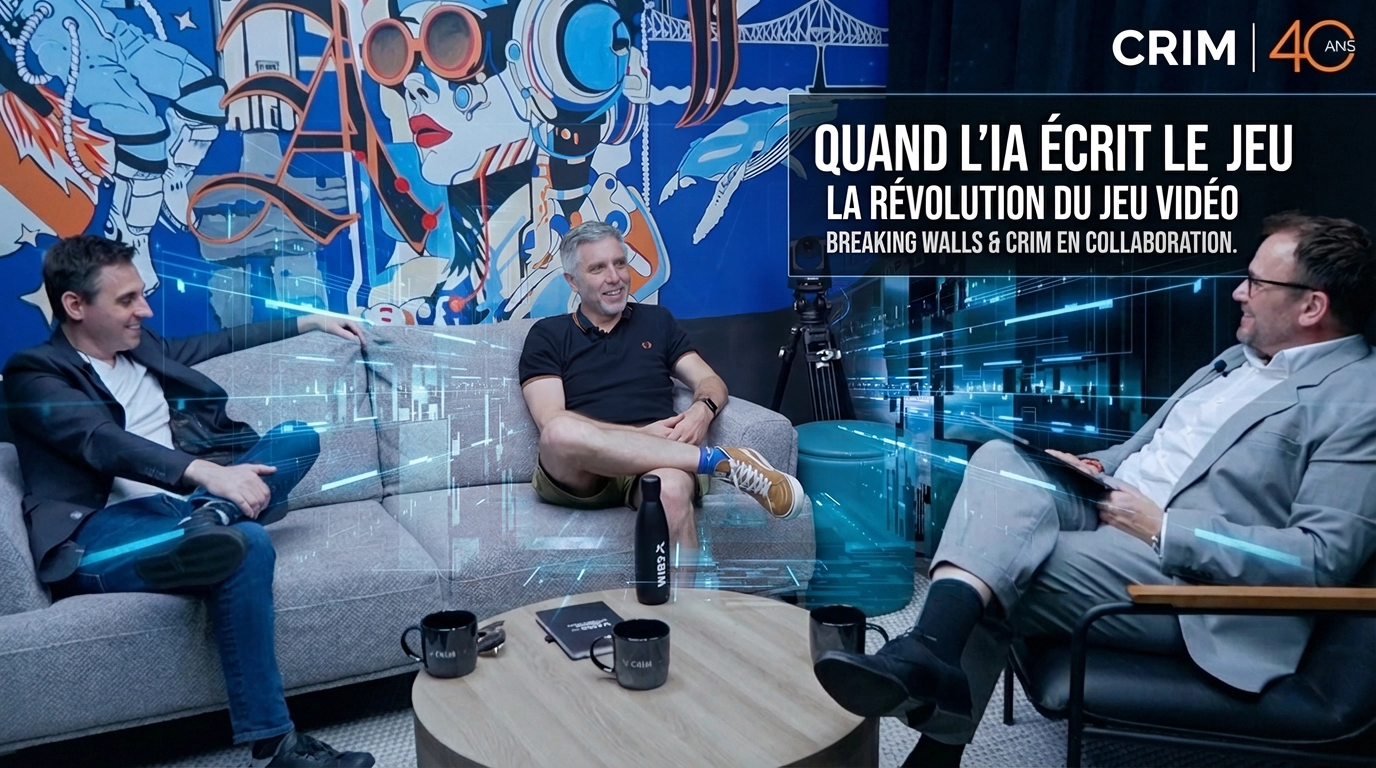
Building an AI game creation platform means solving problems that sit at the intersection of research and product development. We recently joined our partners from CRIM (Computer Research Institute of Montreal) on the Succes IA podcast to talk through the ideas, trade-offs, and technical bets behind Sandscape.
The conversation covers everything from the origins of our studio to where we think no-code game development is headed. Below, we break down the key topics and add context that goes beyond what we covered on camera.
Note: The interview is in French.
Who's in the Room
On our side, Sebastien Nadeau (CTO) and Laurent Bernier (CEO) represent the Breaking Walls team. Laurent started in the industry back in 1999, working in 3D and animation before spending nearly 19 years at Ubisoft across some of its biggest franchises. Sebastien began in cinema and VFX before moving into real-time simulation and software development. The two met at Ubisoft, and the shared experience eventually led them to cofound Breaking Walls. The conversation is hosted by researchers from CRIM, who collaborate with us on the AI research powering the Sandscape engine.
From AAA Studios to an AI Game Development Startup
Sandscape didn't start with a business plan. It started with a question: what would game creation look like if the tools got radically simpler? Before founding Breaking Walls, we spent years at Ubisoft working on titles like Prince of Persia. That environment shaped our understanding of what it takes to build large-scale games, but also showed us how rigid and expensive the traditional pipeline had become.
Years later, we came together to build something different. Our first project was AWAY: The Survival Series, an adventure game that had originally started as a VR experience. From there, we built Venus: Build Your Destiny, an engineering and building game set on the planet Venus. Each project pushed us closer to the idea that eventually became Sandscape: a text-to-game platform powered by generative AI.
How Our Generative Game Engine Works
At its core, Sandscape is a game creation platform and a generative game engine. The goal is straightforward: anyone should be able to create, share, and eventually monetize interactive content (primarily games) without writing code.
We're taking a two-phase approach to make this possible. The first phase is already in alpha. It works like an advanced vibe-coding workflow: you write a prompt, it passes through a series of AI agents and tools, and you get a playable browser-based game. Your interaction stays purely creative. You approve assets, tweak direction, and steer the outcome without touching any code.
The second phase, developed in collaboration with CRIM, adds a generative rendering layer. Instead of relying solely on pre-made assets, diffusion models generate the final visual aesthetic in real time. This is where no-code game development starts to feel less like assembling parts and more like describing a world and watching it materialize.
AI as a Creative Partner, Not a Replacement
Every new creative tool raises the same concern: will it flood the world with low-effort content? With AI game development, that question is especially pointed. If anyone can generate a game in minutes, what prevents an avalanche of mediocre output?
We think the answer comes down to intent. The AI tools that matter are the ones designed for symbiosis with humans, not substitution. They should amplify what a creator already brings to the table: taste, vision, and a point of view. As Sebastien puts it, the tools that will actually have an impact are the ones that let people fully exploit their creative instincts, not the ones that try to replace them.
"Uninspired content is uninspired content, whether it was made by an AI or by a human copying someone else's work. AI is the best hammer available right now, but you still need the architect." — Laurent Bernier, Breaking Walls
The creative process, the intention behind it, the message it carries, that is what separates noise from something worth playing.
The AAA Crisis and the Indie Game Development Opportunity
The games industry is going through a painful correction. Mass layoffs, studio closures, and cancelled projects have become a regular backdrop. It's a combination of overlapping forces: a post-COVID hiring correction, uncertainty about how AI will reshape production costs, consumer fatigue with the same franchises that have dominated for nearly two decades, and fierce competition for attention from social media and short-form content.
A single AAA title can now cost $300 million or more to produce. At that scale, the risk of trying something genuinely new becomes almost unacceptable. And that is exactly where the opportunity opens up for indie game development. Smaller teams with original ideas and access to better tools can move into the space that large studios are too risk-averse to explore. Sandscape fits into this picture as both a creation platform for independent creators and a rapid prototyping tool for studios looking to test concepts and validate market interest before committing to full production.
The CRIM Research Partnership
Building a generative game engine is not just an engineering challenge. It is a research problem. Generative rendering, real-time diffusion, multi-agent orchestration: these sit at the frontier of what is currently possible. Tackling them requires the kind of deep, methodical investigation that a product-focused startup is not always set up to do alone.
Our partnership with CRIM, funded through the Investissement Quebec innovation program, gives us a way to split the work effectively. CRIM handles the more fundamental research, while we focus on product development and commercialization. In practice, we operate like a single development team, running shared scrums, active follow-ups, and a collaborative dynamic that clicked from the start. Their rigorous approach complemented areas that were not our core strengths. We were surprised by how thorough their initial technology survey was, catching blind spots that had slipped past our own radar.
Advice for Aspiring Game Creators
The barrier to entry for game creation has never been lower. AI game creation tools, accessible engines, and open-source resources mean that someone with a strong idea can build something meaningful without a large team or a big budget.
But lower barriers do not mean lower standards. Understanding the history of your craft still matters. Knowing why certain design patterns work, studying the games that shaped the medium, developing taste through broad exposure: none of that becomes less important just because the tools got better. The people who will stand out are the ones who combine a genuine creative vision with the willingness to learn and adapt as the tooling evolves.
Watch the Full Interview
The full conversation runs about an hour and goes deeper than what we can cover in a blog post. If you are interested in the future of generative game engines, the evolving relationship between AI and game development, or the practical realities of building a text-to-game platform from the ground up, it is worth the watch.
The Sandscape Team